
Soil Structure and Texture Explained for BSc Agriculture Students

A soil sample can look like “just dirt” until it is rolled between the fingers, wetted, broken apart, and studied closely. Then it becomes clear that soil has an internal design. Some soils drain quickly but hold little water. Some stay sticky after rain. Some crumble into small rounded aggregates that roots can enter with ease. Others form hard plates that block air, water, and root growth.
Two properties explain much of this behavior: soil texture and soil structure. They are closely related, but they are not the same. Texture tells what the soil is made of by particle size. Structure tells how those particles are arranged. Together, they affect tillage, irrigation, nutrient availability, erosion, seed germination, and crop yield.
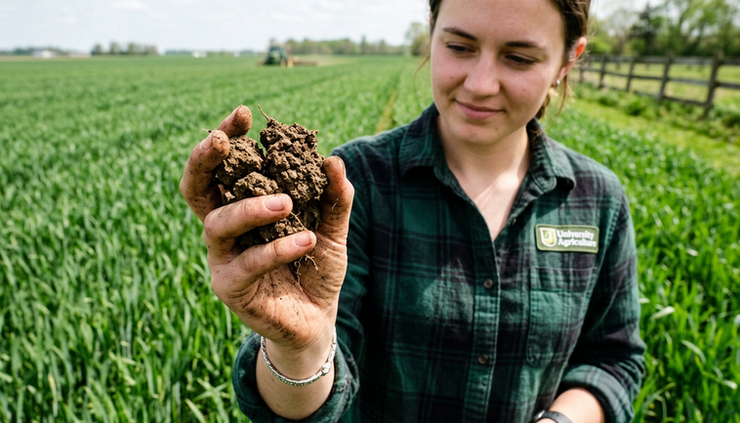
Soil texture explains the particle size composition
Soil texture refers to the relative proportion of sand, silt, and clay in a soil. These are called soil separates. They differ mainly in particle size, which gives each one a different feel and behavior.
The common USDA size limits are:
Soil separate | Particle size | Field feel | Main behavior |
Sand | 2.0 to 0.05 mm | Gritty | Drains fast and warms quickly |
Silt | 0.05 to 0.002 mm | Smooth or flour-like | Holds water better than sand |
Clay | Less than 0.002 mm | Sticky and plastic when wet | Holds water and nutrients strongly |
Sand particles are large and have wide spaces between them. Water moves through sandy soil quickly, so these soils often need frequent irrigation. They are usually easy to till but may have low nutrient-holding capacity.
Silt particles are smaller than sand and feel smooth. Silty soils can be fertile, but they are also prone to crusting and erosion if left bare.
Clay particles are extremely small and have a large surface area. Clay soils can hold more water and nutrients, but they may drain slowly and become hard when dry. Wet clay soils are easily compacted if worked at the wrong time.
A soil rarely contains only one separate. Most agricultural soils are mixtures. Their texture class is named according to the dominant proportions, such as sandy loam, clay loam, silty clay, or loam.
The soil textural triangle helps classify soil
The soil textural triangle is the standard tool used to classify soil texture. It uses the percentage of sand, silt, and clay to identify a textural class.
For example, a soil with about 40% sand, 40% silt, and 20% clay usually falls near the loam class. A loam soil is often considered favorable for crop production because it balances drainage, water storage, aeration, and nutrient retention.
To use the triangle:
Find the percentage of clay on the left side.
Find the percentage of sand along the bottom.
Find the percentage of silt on the right side.
Follow the guide lines inward until the three lines meet.
Read the texture class at the point of intersection.
Texture can be estimated in the field by the feel method, but accurate classification needs laboratory analysis. A common lab method is the hydrometer method, which estimates particle-size distribution based on sedimentation in water.
The feel method is still useful in farms and field practicals. A moist soil sample can be rubbed between fingers, rolled into a ribbon, and judged for grittiness, smoothness, stickiness, and plasticity.
A simple field feel guide
Sandy soil
Feels gritty and does not form a stable ball.
Silty soil
Feels smooth like flour and forms a weak ball.
Clayey soil
Feels sticky and can form a long ribbon when pressed between thumb and finger.
Loam soil
Feels balanced, forms a ball, and breaks apart with gentle pressure.

Soil structure explains how particles are arranged
Soil structure refers to the way sand, silt, clay, and organic matter bind together into units called aggregates or peds. These aggregates create pore spaces between and within them.
The difference is simple:
Texture is the soil’s particle-size composition. Structure is the soil’s arrangement.
Texture changes very slowly because it depends on parent material and long-term soil formation. Structure can change much faster through cultivation, compaction, organic matter addition, root growth, wetting and drying, and biological activity.
Good structure creates a balanced pore system. Large pores allow drainage and air movement. Small pores hold water for plant use. This balance supports root growth and microbial activity.
Poor structure can cause several problems:
Waterlogging after rainfall or irrigation
Surface crusting and poor seedling emergence
Hard layers that restrict root penetration
Low oxygen around roots
More runoff and erosion
Difficulty in tillage
For BSc Agriculture students, this link is central. Many crop problems that appear to be related to fertilizer or irrigation actually begin with soil physical condition.
Common types of soil structure
Soil structure is described by shape, size, and grade. Shape refers to the form of the peds. Size refers to whether the peds are fine, medium, or coarse. Grade refers to how clearly the peds are formed.
Granular structure
Granular structure consists of small, rounded aggregates. It is common in surface soils rich in organic matter. This structure is very favorable for seed germination, root growth, infiltration, and aeration.
Well-managed garden soils, grassland soils, and soils under cover crops often show granular structure near the surface.
Blocky structure
Blocky structure has cube-like peds. It may be angular or subangular. This structure commonly occurs in subsoil horizons, especially where clay content is moderate to high.
Blocky structure can be good for root growth if the peds are not too large and the soil is not compacted.
Prismatic and columnar structure
Prismatic structure has vertical, pillar-like peds. It is often found in subsoils, especially in clayey soils. Water and roots may move along cracks between the prisms.
Columnar structure is similar, but the tops of the columns are rounded. It is often associated with sodium-affected soils. Such soils may have poor physical condition and low infiltration.
Platy structure
Platy structure has thin, flat, plate-like units. It often restricts downward water movement and root penetration. Platy structure may form due to compaction, traffic, or natural soil-forming processes.
A platy layer near the surface can cause poor emergence because seedlings struggle to break through.
Single-grain and massive structure
Single-grain structure occurs when particles do not bind into aggregates. It is common in loose sandy soils.
Massive structure occurs when soil has no clear planes of weakness and breaks into large clods. It can limit air movement, drainage, and root growth.

Texture and structure affect crop growth in different ways
Texture sets the basic potential of a soil. Structure decides how much of that potential is expressed under field conditions.
A sandy soil will not become a clay soil through management. But its structure and fertility can improve with organic matter, residue retention, and careful irrigation. A clay soil will always contain fine particles, but good aggregation can make it more workable and better drained.
Water movement and storage
Sandy soils have rapid infiltration but low water-holding capacity. Clay soils hold more water, but some of it may be held too tightly for plants to use. Loam soils often provide a better balance.
Structure affects how water enters and moves through the soil. A clay loam with stable granular structure can absorb rainfall better than the same soil after compaction. A crusted surface can produce runoff even when the subsoil has storage capacity.
Aeration and root respiration
Roots need oxygen for respiration. Microorganisms also need air to decompose organic matter and cycle nutrients.
Well-structured soil has pores that allow gas exchange. Poorly structured or compacted soil has fewer large pores. After irrigation or rain, these soils may remain saturated longer, leading to oxygen stress.
Nutrient retention
Clay and organic matter carry electrical charges that hold nutrient ions. This gives clayey and organic-matter-rich soils a higher cation exchange capacity than sandy soils.
Still, nutrients must reach roots. If structure is poor, roots may not explore enough soil volume. Fertilizer response may stay low even when nutrients are present.
Tillage and field operations
Texture affects the workable moisture range. Sandy soils can usually be tilled soon after rain. Clay soils must be handled more carefully. If plowed too wet, clay soil may smear and compact. If tilled too dry, it may form hard clods.
Structure affects draft requirement, seedbed quality, and equipment timing. Good structure reduces the need for repeated tillage.
Soil aggregation depends on binding agents
Aggregates form when soil particles are brought together and held by natural binding materials. Several agents help this process.
Important binding agents include:
Organic matter
Humus acts like a binding material and improves aggregate stability.
Plant roots
Roots push through soil, release organic compounds, and create channels.
Fungal hyphae
Fungal threads help hold particles together.
Clay minerals
Clay particles can bind with organic matter and cations.
Calcium
Calcium helps flocculate clay particles, especially in many agricultural soils.
Microbial products
Bacteria and fungi produce sticky substances that support aggregation.
Wet and dry cycles also influence aggregation, especially in clay soils. Freezing and thawing can have similar effects in colder regions.
Stable aggregates resist breakdown when hit by raindrops or irrigation water. Unstable aggregates slake quickly, clog pores, and lead to crusting.
Soil structure can be damaged by poor management
Texture is difficult to change, but structure is easy to damage. Field traffic, excessive tillage, low organic matter, and working soil when wet are common causes.
Compaction
Compaction reduces pore space and increases bulk density. Heavy machinery, repeated passes, grazing animals, and tillage at high moisture can compact soil.
Common signs include:
Shallow root systems
Water ponding after rain
Poor crop stand
Hard layers below the tilled zone
Uneven crop growth across the field
A penetrometer can help detect compacted layers, but roots also tell the story. If roots grow sideways along a hard layer, the soil may have a physical barrier.
Crusting
Surface crusting occurs when aggregates break down and fine particles seal the surface. It is common in soils with high silt content and low organic matter.
Crusting can reduce infiltration and block seedling emergence. Crops with small seeds are especially vulnerable.
Excessive tillage
Tillage can create a fine seedbed, but repeated tillage breaks aggregates and speeds organic matter loss. It may also form a compacted layer below the plow depth, often called a plow pan.
Reduced tillage, residue cover, and crop rotation can help rebuild structure over time.
Practical ways to assess soil texture and structure
Field observation is a core skill in soil science. A simple soil pit, spade, or auger can reveal more than a surface glance.
For texture, use the feel method:
Take a small soil sample.
Remove gravel and plant residues.
Add water slowly until the soil becomes moldable.
Rub it between fingers to check grittiness or smoothness.
Press it into a ribbon between thumb and finger.
Estimate whether sand, silt, or clay dominates.
For structure, observe a fresh clod or soil slice:
Does it break into natural aggregates?
Are the aggregates rounded, blocky, platy, or massive?
Are roots entering the aggregates or only growing between cracks?
Does water enter easily or run off?
Does the soil smell earthy and show biological activity?
Are earthworm channels or old root channels visible?
A useful test is the slake test. Place a dry aggregate gently in clear water and observe. A stable aggregate holds its shape longer. A weak aggregate falls apart quickly and clouds the water.
Management practices that improve soil structure
Good soil structure grows from repeated good management. No single practice fixes all soils.
Add organic matter regularly
Farmyard manure, compost, crop residues, green manure, and cover crops support aggregation. Organic matter feeds soil organisms and improves water-holding capacity.
The effect is strongest when additions are regular. One application may help, but long-term improvement needs a steady return of biomass.
Keep the soil covered
Bare soil is exposed to raindrop impact, erosion, and temperature extremes. Crop residues, mulches, and cover crops protect aggregates at the surface.
Soil cover also slows runoff and gives water more time to infiltrate.
Use crop rotation
Rotations with legumes, grasses, and deep-rooted crops improve root diversity. Different root systems create pores at different depths.
Fibrous roots help build surface aggregation. Taproots can penetrate deeper layers and leave channels after decomposition.
Avoid working soil when it is too wet
A simple field check helps. Take soil from tillage depth and squeeze it in the hand. If it forms a sticky ribbon or smears, it is too wet. If it crumbles under light pressure, it is closer to the right condition.
Working wet soil may save time on one day but cause structure problems for a season or longer.
Reduce unnecessary traffic
Controlled traffic farming, lower axle loads, and avoiding repeated passes can reduce compaction. Keeping machinery off wet fields is especially important.
In smaller farms, even repeated foot traffic or animal movement can compact surface soil.
Correct chemical problems when needed
Some soils have structural problems due to sodium. In sodic soils, clay particles disperse, leading to poor infiltration and hard setting. Gypsum may help where sodium is the cause, but it should be based on soil testing and proper diagnosis.
Not every hard soil needs gypsum. Texture, pH, salinity, sodicity, drainage, and organic matter all need consideration.

Key differences between soil texture and soil structure
Feature | Soil texture | Soil structure |
Meaning | Proportion of sand, silt, and clay | Arrangement of particles into aggregates |
Main basis | Particle size | Aggregation and pore arrangement |
Change over time | Changes very slowly | Can change within seasons or years |
Field method | Feel method and ribbon test | Aggregate shape, grade, slake test |
Crop effect | Controls basic water and nutrient behavior | Controls root growth, aeration, infiltration, and workability |
Management response | Hard to change directly | Can improve with good practices |
Both properties work together. A clay soil with strong granular structure may support crops better than a sandy soil with poor fertility and low water retention. A loam soil can perform poorly if compacted. Soil evaluation should always consider both.
Takeaway for agriculture students
Soil texture and structure are foundation topics in soil science because they connect physical properties with real field decisions. Texture explains the size composition of soil particles. Structure explains how those particles form aggregates and pore spaces.
In crop production, these ideas guide irrigation scheduling, drainage planning, tillage timing, fertilizer use, erosion control, and soil conservation. The best way to learn them is not only through diagrams and definitions, but through handling soil in the field.
Take a spade, collect samples from different depths, feel the texture, break the clods, look for roots, and observe how water behaves. A well-trained eye can read soil structure and texture before any lab report arrives, and that skill is essential for sound agricultural practice.


Comments